> For the complete documentation index, see [llms.txt](https://docs.innofalls.com/llms.txt). Markdown versions of documentation pages are available by appending `.md` to page URLs; this page is available as [Markdown](https://docs.innofalls.com/getting-started/data-fields/stack-columns.md).

# Stack / Columns

The *Stack / Columns* field can be used to either stack values of a dimension on top of each other or to split values into columns (or rows in time orientation). Whether stacks or columns are created is determined by the *Stack / Column mode* in the menu. The default setting is *Stack Mode*.

### Stacking

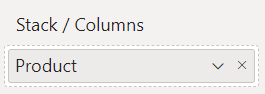
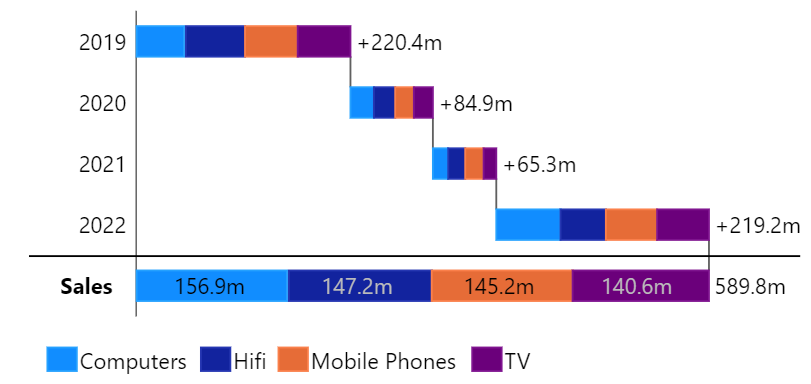
Besides adding multiple measures into the *Values* field, you can create a stacked waterfall or bar chart by adding a dimension into the *Stack / Columns* field while in **Stack Mode**.

<img src="/files/uzlSzOgpvmtlLVd5neeK" alt="" data-size="original">

Each element of the chart is then split into multiple segments. The basic bar chart creates multiple series from the stacking dimension.

<figure><img src="/files/su0YmrYzPHuSLKr8B2hI" alt="" width="375"><figcaption><p>Stacking by Product, "Power BI" Theme for more contrasting colors</p></figcaption></figure>

### Columns

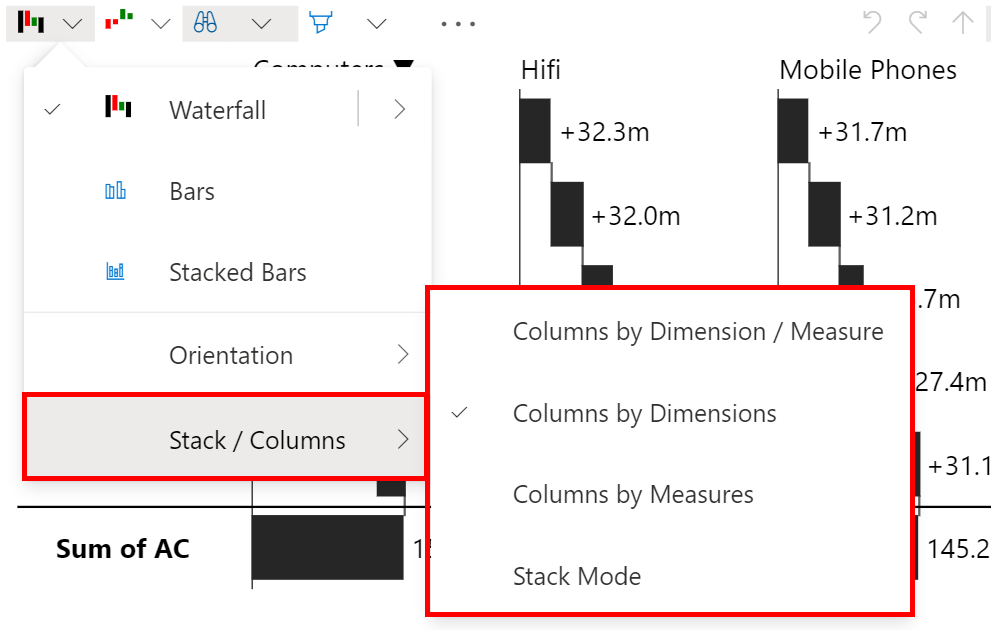
Another use of this field is splitting the chart into multiple columns in **Column Mode**. You can select this mode in the menu:

<figure><img src="/files/r0YB8DN6k5SLOKvhCZm7" alt="" width="375"><figcaption><p>Stack / Column Mode Selection</p></figcaption></figure>

{% hint style="info" %}
You can also select the Stack / Columns Mode in the property pane.
{% endhint %}

You have the choice of three modes for columns, which allow for each combination of stacking and/or columns of the *Stack / Column* dimension and multiple measures in the *Values* field.

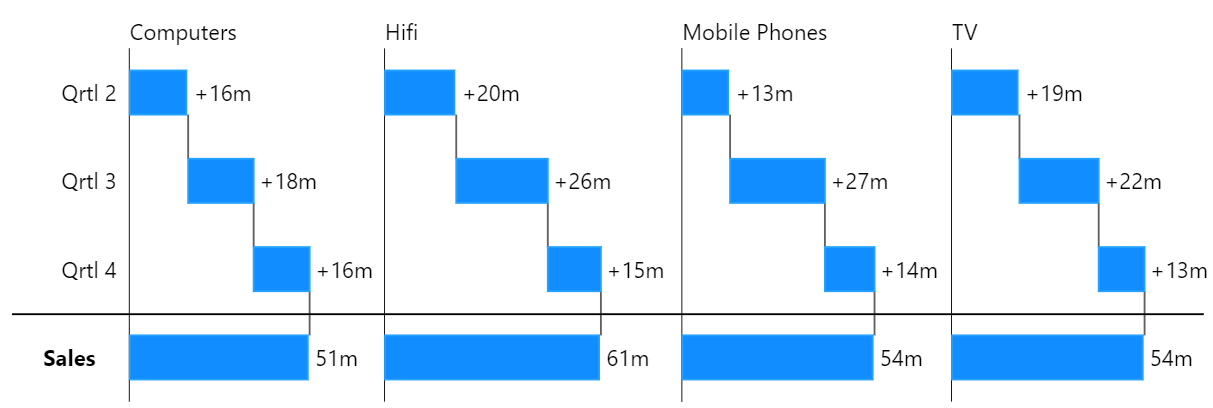
<table data-header-hidden><thead><tr><th></th><th></th><th data-hidden></th></tr></thead><tbody><tr><td>Columns by Dimension / Measure</td><td><p>Create a column for each combination of measures and members.</p><p>A dimension Product with 4 members and 2 measures in values creates 4 x 2 = 8 columns.</p></td><td></td></tr><tr><td>Columns by Dimensions</td><td>One column for each member of the <em>Stack / Column</em> dimension. Multiple measures in the <em>Values</em> field are being stacked.</td><td></td></tr><tr><td>Columns by Measures</td><td>One column for each measure. The dimension from the <em>Stack / Column</em> field is used for stacking.</td><td></td></tr></tbody></table>

<figure><img src="/files/OzE6pIzIHV5cPjDcPN1l" alt=""><figcaption><p>Columns by Dimension (Product)</p></figcaption></figure>

{% hint style="warning" %}
Please note that for performance reasons the count of columns is limited to 12.
{% endhint %}