> For the complete documentation index, see [llms.txt](https://docs.innofalls.com/llms.txt). Markdown versions of documentation pages are available by appending `.md` to page URLs; this page is available as [Markdown](https://docs.innofalls.com/chart-types/special-value-treatment.md).
# Special Value Treatment
In certain scenarios, especially when creating income statements and similar financial reports, you might need to treat specific members differently to accurately reflect the data. The Special Value Treatment feature in Innofalls Charts provides various options to customize how individual members are displayed and calculated within your waterfall charts.
**How to Apply Special Value Treatment**
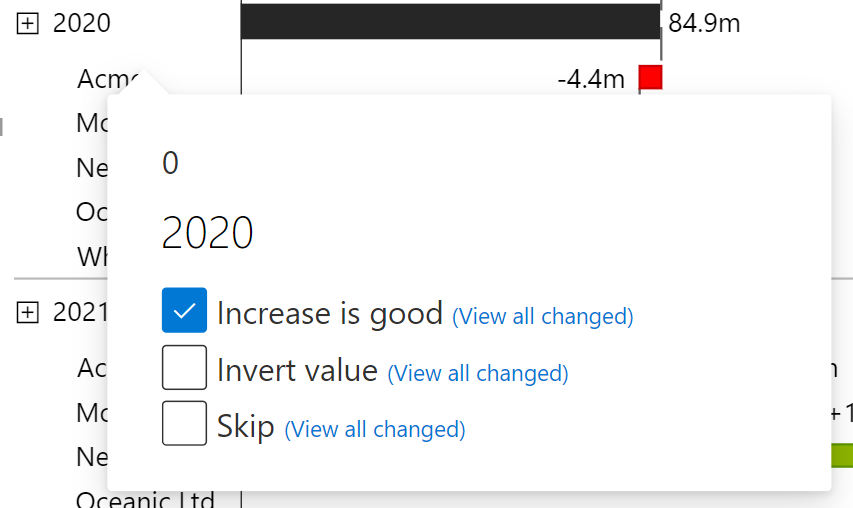
While in edit mode, click on a category label to access further options for that specific category or member. You will see three checkboxes that allow you to modify the treatment of the member:
The options available after clicking 2020
1. **Increase is Good:**
* **Default Setting:** This option is checked by default, meaning increases in this category will be shown in green, indicating positive impact.
* **When Deselected:** If you deselect this option, increases will be shown in red (negative impact), and decreases in green (positive impact). This is particularly useful for cost categories, where an increase typically represents a negative business outcome.
2. **Invert Value:**
* **Default Setting:** This option is unchecked by default.
* **When Selected:** Selecting this option will invert all values associated with this member, including its child elements, ensuring a valid breakdown of the chart. This is useful when costs are entered as positive values but need to be displayed as negative for accurate representation.
3. **Skip:**
* **Default Setting:** This option is unchecked by default.
* **When Selected:** This option will exclude the selected value from the waterfall chart calculations, effectively ignoring it in the breakdown.
**Overview Window**
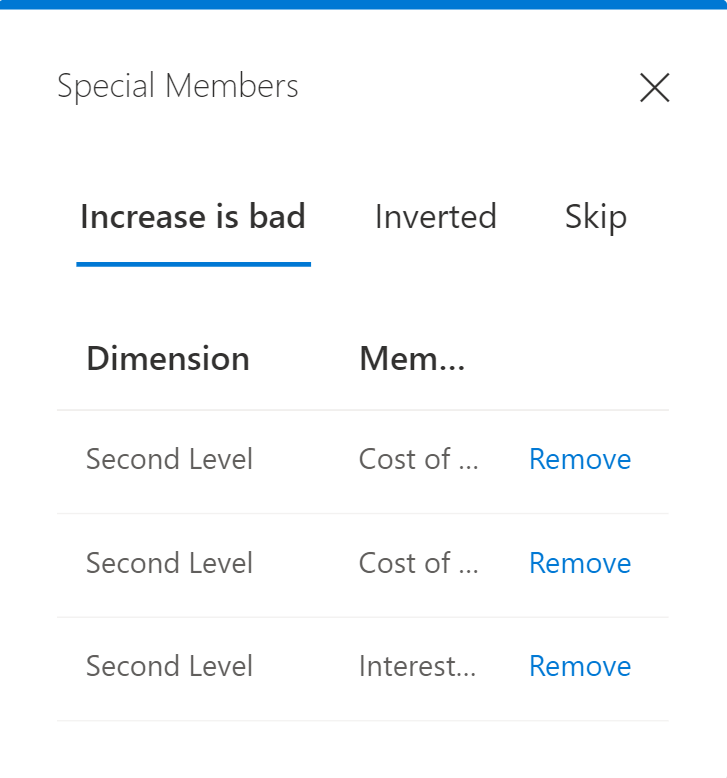
Next to each checkbox, there is a link labeled "View all changed." Clicking this link opens a window that provides an overview of all members with special treatments applied. From this window, you can manage and remove these special treatments as needed.
Keep an overview of the special members
#### Practical Example
Imagine you are working on an income statement and you have costs recorded as positive values. By using the "Invert Value" option, you can ensure these costs are displayed correctly as negative values, providing a more accurate representation of your financial data.
{% hint style="success" %}
There is an option in the Properties Pane under "Formatting" that inverts all Red/Green colors, in case this applies to all data displayed.
{% endhint %}